
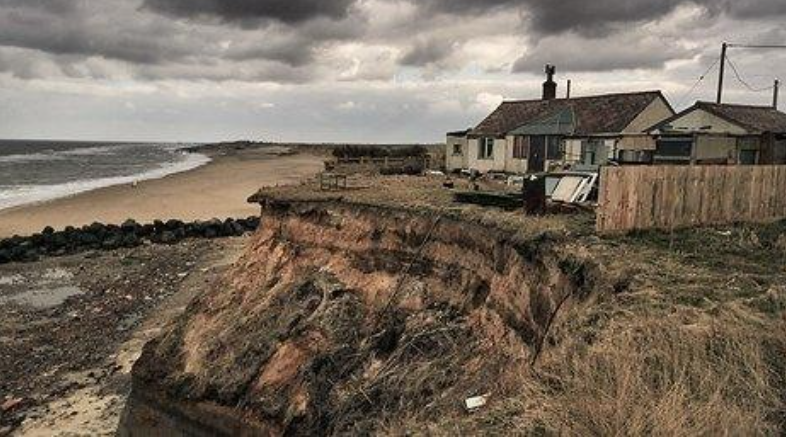
This is part of the Five Generations series, following one British family through the climate emergency from 2035 to 2100. Each story shows two possible futures: what happens if we fail to act, and what becomes possible when we choose climate action. These are not predictions; they are possibilities. The future is not written yet
Story 3 of 10.
By the 2040s, sea level rise and increased storm intensity have made coastal change impossible to ignore. Decisions about managed retreat, compensation, and community relocation define this generation’s experience.
How society handles this transition reveals whether we planned for adaptation or merely reacted to the crisis.
Your Daughter, Age 18
Your daughter turned eighteen in 2043. She should be celebrating finishing her A-levels, thinking about university, and planning her future. Instead, she is helping her grandmother pack; she is watching her family’s history being boxed up and abandoned to the sea.
The family home in Norfolk, where three generations gathered every summer, where your daughter learned to swim in the sea, where her grandfather proposed to her grandmother fifty years ago, is being abandoned.
Not suddenly, through a single catastrophic flood, but through something more insidious: the slow, relentless certainty that this place is no longer viable.
“The insurance companies saw it coming. The government saw it coming. Everyone saw it coming except the people who lived there.”
The coastal erosion has accelerated beyond all management capacity. Storm surges that used to be once-in-a-decade events now arrive twice a year. Last winter, seawater filled the ground floor. The insurance company stopped covering the property in 2041. The local council has placed it in the ‘managed retreat’ zone.
What a phrase. Managed retreat. As if there is anything managed about grief, about displacement, about losing the place that holds your memories.
The Science Behind This Story, Properties at risk:
Research published in Ocean and Coastal Management by the Tyndall Centre for Climate Change Research at the University of East Anglia found that nearly 200,000 properties in England are at risk of being abandoned from the 2050s due to sea level rise. This figure includes 120,000 to 160,000 properties where the cost of protection may be too high or technically impossible, in addition to 30,000 to 35,000 properties already identified as at risk in existing shoreline plans
Sea level rise projections: Mean sea levels around England could be up to 30 to 35 centimetres higher by 2050 than their historical baseline and will continue to rise throughout the century. Under high emissions scenarios, UK Climate Projections 2018 indicates sea levels could rise by 1 to 2 metres by 2100. The Intergovernmental Panel on Climate Change has advised that a global sea level rise of 2 metres by 2100 cannot be ruled out.
Coastal erosion acceleration: The Environment Agency’s 2024 National Assessment of Flood and Coastal Erosion Risk shows that approximately 3,500 properties are currently in areas at risk of coastal erosion in the period up to 2055. Even with all shoreline management plan investments delivered, this figure could rise to 19,700 properties by the end of the century. Without investment, the figure is expected to be five times greater.
Regional impacts: The local authorities facing the largest challenges from sea level rise through to the 2050s and 2080s include North Somerset, Wyre, Swale, Tendring, Maldon, Suffolk Coastal, North Norfolk, Cornwall, Medway, and Sedgemoor. Around 30% of England’s coastline, currently designated for ‘hold the line’ policies, may become increasingly difficult to protect.
Precedent for managed retreat: In 2014, the village of Fairbourne in Wales became the first UK community to be told by the local council it would no longer be defended against rising sea levels. Approximately 1,000 residents will be evacuated and relocated by 2054 or earlier if the town becomes uninhabitable. The town of Happisburgh in Norfolk has already lost numerous properties to coastal erosion, with the cliff edge advancing by several metres in some storm events.
Sources: Tyndall Centre for Climate Change Research (2022); UK Climate Projections 2018; Environment Agency National Assessment of Flood and Coastal Erosion Risk (2024); Climate Change Committee Third UK Climate Change Risk Assessment

Your daughter watches her grandmother cry as she packs photograph albums, as she takes a final walk on the beach where the cliff edge now stands metres closer than it did when she was a child. Your daughter is angry. She is furious.
She asks why this was allowed to happen. Why is her inheritance saltwater and displacement? Why the people in power, the people who knew, the people who could have acted, chose profit and convenience over her grandmother’s home, over her childhood, over her future.
She is also one of 1.2 million people in the UK who now live with significant flood risk, a number that will continue to grow. She is learning that in climate change, loss is not always dramatic. Sometimes it is quiet, cumulative, and absolutely devastating. Sometimes it is watching your grandmother walk away from the only home she has ever known, carrying what she can save, leaving the rest to the water.
Your daughter will never forgive the generation that let this happen. Can you blame her?
The grandmother’s fate in 2043 depends entirely on whether adaptation planning began in the 2020s or was deferred until the crisis made action inevitable.
The difference between managed retreat with dignity and desperate abandonment. Between compensation that reflects genuine care for displaced communities and token payments that add insult to injury. Between a society that protects its most vulnerable members and one that leaves them to face loss alone.
These are not technical questions. They are only moral ones.
Next week: Story 4: The coast that adapts, same story but the hopeful version.
“Your daughter watches her grandmother walk through rooms filled not with grief but with photographs being carefully packed for the new house. The move is bittersweet, yes, but it is dignified. Fair. Planned”